
My friend and co-fanatic in music, Andrew Cronshaw, has been writing for many years about the world's musical gems, and at long last, he has taken all of the reviews he has done in fRoots Magazine and put them online in an archive. It's all neatly arranged and cleanly presented, in typical Cronshaw style. 1500 recordings, primarily from northern, central and eastern Europe and Iberia, with interesting forays into the rest of the world. He can be loving or searing as needed, and I hope you will take some time to just wanted aimlessly through this treasure chest in the months to come.
Check them all out here
Here is a sampling of the reviews you will find there:
Since Andrew and I first met in Finland in 1994, I thought that was an appropriate time and place to begin:
VARIOUS ARTISTS
Entiset Etniset - Historical direct disc recordings of Finnish folk music 1935-1954
Kansanmusiikki-instituutti KICD 29 (1993)
EINO TULIKARI
Traditional Finnish kantele music
Kansanmusiikki-instituutti KICD 1 (1993)
AARNION SISARUKSET (The Aarnio family band)
Hameen Polkka; Finnish folk music from the 1930s
Kansanmusiikki-instituutti KICD 28 (1993)
RÖNTYSKÄ
Röntyskä Songs
Mipu Music MIPUCD 203 (1993)
From 1935 until 1954 performances for A.O.Väisänen's Finnish radio programme Puoli tuntia kansanmusiikkia ("Half an Hour of Folk Music") were pre-recorded on 8-minute acetates. Most of these were scrapped after use, but a random selection were preserved, and selected items have now been No-Noise reprocessed and released on CD as Entiset Etniset. The result is a collection of music, much of it unheard since the 30s, produced by rural traditions around Finland before the Winter War changed everything - kantele masters such as the Karelians Vanja Tallas and Antero Vornanen, Ingrian-born wind-instrumentalist Teppo Repo, singers in the old styles, a scattering of ocarina, clarinet, harmonium and melodeon, and of course fiddlers.
Eino Tulikari appears too, but there are more recent recordings of him, in fact a whole LP, made in 1975 in the front room of the Folk Music Institute's beautiful wooden Pelimannitalo at Kaustinen, when this leading exponent of the still-flourishing Perho River Valley style of kantele playing was 70. (This CD reissue of that album adds four tracks from a recording made for radio twenty years earlier.) He played the large "board kantele"; in his Ostrobothnian regional style it's played with the shortest string toward the player and without damping. On record, the sound is attractively music-box-like, but the intricate and ingenious techniques Tulikari used in these tunes, largely polkkas, marches and waltzes, are a continuing strong influence on today's players, and to see someone today using what he had a major hand in developing makes clear how important he was. Kantele is music for the eyes as well as the ears.
Incidentally, I'm not a harp player but it occurs to me that some kantele techniques, particularly the ways of slipping across strings for fluid fast playing and grace-note turns, might be worth the attention of those who are.
The Aarnio Family Band album is also compiled from acetates from Väisänen's radio programme. Until this century instrumental folk music was played solo; folk bands didn't really exist until after the 1940s, though there were popular music dance bands and a considerable brass band tradition. Nevertheless, in a home with a number of instrumentalists it was natural that they'd play together. The Aarnio family, from Humppila, SW Finland, started performing in ceremonial wedding plays, with an unusual line-up featuring Väinö Aarnio on clarinet, fiddle and occasional ocarina and his sisters Lempi on fiddle and Hilja on a 24-string kantele (played in the hand-damping, strummed chordal style very unlike Tulikari's, but still with shortest string nearest the player). A third sister, Rauha, played fiddle in the band too but not on these recordings, made in 1936 and 1941. The material here is virtually all polkkas and waltzes, with three mazurkas and a polska, with some influence evident from brass band music, perhaps partly because of Väinö's earlier experience playing cornet. His fiddle solos in particular show him to have been a very able and lively musician.
The recordings of the Röntyskä group of women singers from Rappula in Ingria (the Finno-Ugrian territory in the part of Russia between Finland and Estonia at the head of the Gulf of Finland) aren't from the archives but were made in 1993 of a group formed by Hilma Biss in 1977 on her return from deportation to Siberia and a stay in Karelia to sing the old songs from her home region - ring dances and game songs. The Röntyskä song, a quick 2/4 or 4/4 ring dance after which the group is named, is of antiphonal form; the leader sings a couple of lines of usually light-hearted lyrics reflecting village life and the group repeats them, in unison, sometimes adding a refrain. The singing is straightforward, without grace-noting or harmony, and the main interest of this album, while it has unpretentious charm, probably lies for most listeners largely in the material. The Ingrian tradition is continuous with that of Finland, but until recent developments communication and movement across the border were difficult. Now this group's songs, some of which arrived in Ingria from Finland in the first place, are finding their way back into the repertoire of Finnish musicians.
=================================================
Another thing Andrew and I share is a passion for this unique American artist of Latvian descent:
INGRID KARKLINS & BACKBONE
Red Hand
Willow Music IK001 (1997)
I guess at first listen some Folk Roots readers might regard this album as pretty far from folk music. Ingrid Karklins is, though, a classic example of post-traditionalism, in which each musician has in effect a personal tradition built from all their influences. We just don’t live in villages, largely unaware of any ways of making music other than those in our immediate geographical vicinity, any more. Some of us give in more or less to the pressure of one or other global mainstream; Ingrid Karklins doesn’t.
Her name first appeared in Folk Roots when cassette releases were still reviewed, then again with her first two CDs (on Green Linnet), and in an interview piece. Having parted company with the label, she resolved to make the whole project of her next recording as deeply personal as her songs, and indeed it is, dramatically so. Red Hand comes in a package hand-made by her, using fine papers and red braids, bearing a red imprint of her right hand. The natural impulse of the recipient is the childlike and fundamental one of matching hands, and unwrapping like a present the entirely red, unmarked CD.
The main features of the sound are her voice, which as others have said has some similarity to Laurie Anderson’s, and her piano (and occasional Latvian kokle and fiddle) with Steve Bernal’s bass, Craig No.7’s guitars and the remarkable, innovative and powerful percussion of Thor, who was a shaping factor in her compelling first CD, A Darker Passion, and has returned for this one.
Karklins makes absolutely no claim to performing Latvian traditional music, but her songs, minimal in lyrics, showing her compelling tension between self-exposure and extreme privacy, combine what is deeply personal to her with the oblique symbolism of the Latvian dainas (folksong verses tunnelling through the Latvian experience of many centuries) which are a strong influence. She draws on Malayan pantun, Scottish song, Alexander Pope, Nick Drake, a Dobu Island charm and Randy Newman, but there’s no complete exposition of any of them - they’re threads in the weave.
Remarkable and bold, and, like much great art, on the jagged edge between the mainstream and non-existence. Strangely liberating and encouraging.
=================================================
And finally, a bit of the acid that is an essential element of the Cronshaw DNA:
Oreka Tx
Quercus Endorphina
Elkarlanean KD-579 (2001)
Txalaparta. Two rough, thick planks of wood, resting on soft furs, leaves or cloth draped over upturned baskets or trestles. Two players strike them with thick wooden batons, one held vertically in each hand. A strange, old, minimalist music that explores the slight tonal and timbral variations to be drawn out of each plank by hitting it at the ends, in the middle, on the edge. A subtle musical conversation between two people, each appreciating and responding to the pitches and patterns made by the other.
Along come social and occupation changes, in Euskadi as elsewhere, and the txalaparta tradition gets close to dying out. But some young players, among them Igor Otxoa and Harkaitz Martínez who are Oreka TX, take it up, becoming skilful. They naturally experiment, not only with playing techniques but the instrument’s possibilities.
Why not add a whole lot more planks? Tune them to a scale. And of course if you’re going to want to play with other instruments, it’ll probably need to be that universalised sterilised equal temperament scale, not the old way of notes that sound right to the individual player. And look what you’ve got now! Hey, a rather big and dead-sounding xylophone!
And so, having created a “revamped, stronger and more attractive variant”, to quote the press release, you’re in a position to make it “a feature of cultural distinction, with a touch of ethnic flavour”. But surely the concept of extracting minute subtleties of tone, microtone and rhythm from a pair of heavy rough-hewn planks is more culturally distinctive than a big xylophone playing accordion tunes?
Oh sure, traditions must evolve or they die, and noticeable evolutionary clicks of the cog are usually criticised as crass and destructive, but no amount of criticism ever stopped the process and they often give rise to a new flowering; indeed Oreka TX and this album are a significant part of a considerable upsurge in txalaparta playing. It’s a well-made, stylishly presented record, destined to widen international knowledge and esteem of the instrument, with very skilful txalaparta players (who also make some use of tobera, the iron txalaparta, and the stone, lithophone version), neat trikitixa style tunes, and excellent Euskal and international guests (producer Kepa Junkera, Mikel Laboa, Glen Velez, Phil Cunningham, Justin Vali, Ibon Koteron’s alboka, Michel Bordeleau’s feet).
But something’s missing...
And then, in the 2 minutes 59 seconds of track 8, Oreka (“balance, equilibrium”), suddenly there it is. And on the last track, not just in the woody staccato from a 1990 recording of a pair who carried txalaparta through the thin times, Pello Zuaznabar and Ramon Goikoetxea, but also in the overlapping speaking voices, there it is again. Not neat tunes scored and transferred, not one-note-per-plank, but that sensitivity to mere hints of pitch variation, that delight and intensity of concentration of two people improvising in rhythmic co-operation. Txalaparta.
All these reviews appeared in fRoots over the years
All are ©Andrew Cronshaw
Tuesday, April 21, 2009


Thursday, April 16, 2009
RootsWorld's future depends on you
RootsWorld needs your help to survive
Back in 1992, the dawn of time by internet reckoning, I decided to do something unheard of, and create an online global music resource. As it grew, I began to call it a "sharezine," an hommage to my many years as a volunteer DJ at various non-commercial radio stations, who share the music for free, and then ask you to voluntarily support it after the fact - free and open to all, access permitted at all times, to everyone. It just seemed like the right way to do it.
As RootsWorld grew over the years, it has been a search engine, a magazine, a juke box and much more, evolving, changing - growing and shrinking and growing again. It was sometimes a part time endeavor, sometimes my life's work. It has been a series of experiments. Some failed, some thrived.
But it has always been, in my opinion, about quality, not quantity, and it still is. We do not publish more reviews than most online resources - we publish more thoughtful reviews. We do not put out a steady stream of reiterated and regurgitated press releases and blurbs - we tell you about things we find interesting, important or inspiring. We do not flood you with content (how I hate that bit of internet phasing!) - we send you good reading and listening, only when we have it to send you - no filler, no dross. The volunteers who contribute to RootsWorld are free to tell you what they think - to enlighten you, not please an advertiser, a record label, an artist or a publicist. They write with passion, with spirit, with wit and intelligence.
So you know what comes now: the pitch.
This is the first time in the history of RootsWorld that I have dedicated this much space and time to asking you for your help, but today is that day. A few years ago, I changed RW's funding to a low-key voluntary system of support, and it has paid some of the bills. I added cdRoots to the mix and it was a successful subsidy for a while, as well, offering you a place to find the music you read about (and much more). But as I am sure you know, things change. CD retailing is waning. The internet is awash in "free information" (judge it as you will for value) delivered amid a sea of visual flotsam. Little discrete text ads and Amazon links do not pay the bills.
SO: The pitch is pretty simple:
Contribute to RootsWorld - I cannot do it without your support.
Many of you have responded over the last year with just that - generous financial support that allows me to continue to publish these newsletters and the web site without blocking it from all who want to read it - that SHAREZINE idea. I thank you for that support.
Now I need to ask YOU to join them, to make a financial contribution in lieu of a formal "subscription" to help me keep RootsWorld 'on the air.'
Please consider making that contribution right now, by clicking the button below, or ssimply drop a check to:
RootsWorld
Box 1285
New Haven CT 06505
Let's show the big business analysts, the flash-splash video ad-sellers and commercial nay-sayers that a small community can prosper in the big corporate world of the World Wide Web.
Thanks
Cliff Furnald
Writer wrangler, code puncher, web rider
If you have not yet decided to contribute, but you would like to be on our mailing list for a while to check it out, please sign up
Your e-mail address will NEVER EVER be given to anyone else, for any purpose.
Back in 1992, the dawn of time by internet reckoning, I decided to do something unheard of, and create an online global music resource. As it grew, I began to call it a "sharezine," an hommage to my many years as a volunteer DJ at various non-commercial radio stations, who share the music for free, and then ask you to voluntarily support it after the fact - free and open to all, access permitted at all times, to everyone. It just seemed like the right way to do it.
As RootsWorld grew over the years, it has been a search engine, a magazine, a juke box and much more, evolving, changing - growing and shrinking and growing again. It was sometimes a part time endeavor, sometimes my life's work. It has been a series of experiments. Some failed, some thrived.
But it has always been, in my opinion, about quality, not quantity, and it still is. We do not publish more reviews than most online resources - we publish more thoughtful reviews. We do not put out a steady stream of reiterated and regurgitated press releases and blurbs - we tell you about things we find interesting, important or inspiring. We do not flood you with content (how I hate that bit of internet phasing!) - we send you good reading and listening, only when we have it to send you - no filler, no dross. The volunteers who contribute to RootsWorld are free to tell you what they think - to enlighten you, not please an advertiser, a record label, an artist or a publicist. They write with passion, with spirit, with wit and intelligence.
So you know what comes now: the pitch.
This is the first time in the history of RootsWorld that I have dedicated this much space and time to asking you for your help, but today is that day. A few years ago, I changed RW's funding to a low-key voluntary system of support, and it has paid some of the bills. I added cdRoots to the mix and it was a successful subsidy for a while, as well, offering you a place to find the music you read about (and much more). But as I am sure you know, things change. CD retailing is waning. The internet is awash in "free information" (judge it as you will for value) delivered amid a sea of visual flotsam. Little discrete text ads and Amazon links do not pay the bills.
SO: The pitch is pretty simple:
Contribute to RootsWorld - I cannot do it without your support.
Many of you have responded over the last year with just that - generous financial support that allows me to continue to publish these newsletters and the web site without blocking it from all who want to read it - that SHAREZINE idea. I thank you for that support.
Now I need to ask YOU to join them, to make a financial contribution in lieu of a formal "subscription" to help me keep RootsWorld 'on the air.'
Please consider making that contribution right now, by clicking the button below, or ssimply drop a check to:
RootsWorld
Box 1285
New Haven CT 06505
Let's show the big business analysts, the flash-splash video ad-sellers and commercial nay-sayers that a small community can prosper in the big corporate world of the World Wide Web.
Thanks
Cliff Furnald
Writer wrangler, code puncher, web rider
If you have not yet decided to contribute, but you would like to be on our mailing list for a while to check it out, please sign up
Your e-mail address will NEVER EVER be given to anyone else, for any purpose.
Wednesday, April 15, 2009
Mandolin, tuba and voice: the new sound of old Marseille
Daniel Malavergne, Patrick Vaillant and Manu Théron
Chin Na Na Poun
Daqui (www.daqui.fr)
I have been following mandolinist Patrick Vaillant's career for pretty much its entirety (well, its recorded entirety, anyway), from his folk and avant garde work in various ensembles with Riccardo Tesi through remarkable ensembles like the mando-centric Melonious Quartet. Of late he has been exploring songs instead of strictly instrumental work and Chin Na Na Poun offers one of his most unique works to date in a trio with Daniel Malavergne and Manu Théron .
Victor Gelu was a songwriter and poet of nineteenth century Marseille, classically trained but enamored with the streets of this rough and tumble seaport. The poems are earthy, sometimes crude in both content and construction, and the offer a clever musical ensemble an opportunity to expand their meaning. Singer Théron, tuba player Malavergne and Vaillant take full advantage of the structural quirks of Gelu and create a compelling poetry of their own, a conversational approach that is at times lyrical, at times confrontational. Their reinterpretations are not meant to be period pieces, and bear little resemblance to what Gelu might have intended for his times, but they are certainly of a street-wise style he would have embraced.
Victor Gelu's poetry was all written in Occitan, so the booklet's French translations of the title track (no other lyrics are included) are a welcome aid to exploring the poetry a bit, but for the most part, the instrumental arrangements provide their own rich, if more cryptic, interpretation of life in 19th Century Marseille, even if seen through a 21st Century 'world music' lens. - CF
Listen
CD available from cdRoots
Chin Na Na Poun
Daqui (www.daqui.fr)
I have been following mandolinist Patrick Vaillant's career for pretty much its entirety (well, its recorded entirety, anyway), from his folk and avant garde work in various ensembles with Riccardo Tesi through remarkable ensembles like the mando-centric Melonious Quartet. Of late he has been exploring songs instead of strictly instrumental work and Chin Na Na Poun offers one of his most unique works to date in a trio with Daniel Malavergne and Manu Théron .
Victor Gelu was a songwriter and poet of nineteenth century Marseille, classically trained but enamored with the streets of this rough and tumble seaport. The poems are earthy, sometimes crude in both content and construction, and the offer a clever musical ensemble an opportunity to expand their meaning. Singer Théron, tuba player Malavergne and Vaillant take full advantage of the structural quirks of Gelu and create a compelling poetry of their own, a conversational approach that is at times lyrical, at times confrontational. Their reinterpretations are not meant to be period pieces, and bear little resemblance to what Gelu might have intended for his times, but they are certainly of a street-wise style he would have embraced.
Victor Gelu's poetry was all written in Occitan, so the booklet's French translations of the title track (no other lyrics are included) are a welcome aid to exploring the poetry a bit, but for the most part, the instrumental arrangements provide their own rich, if more cryptic, interpretation of life in 19th Century Marseille, even if seen through a 21st Century 'world music' lens. - CF
Listen
CD available from cdRoots
Wednesday, April 01, 2009
Toubab Krewe surf the world
Toubab Krewe
Live at the Orange Peel
Upstream Records (www.toubabkrewe.com)
Detractors no doubt dismiss North Carolina-based Toubab Krewe as a bunch of white guys trying to Africanize jam-band music. Then again, that's probably exactly why their fans (of which I am one) love them. Whatever led them to visit Africa multiple times to discover and embrace the sounds of Mali, Guinea and Ivory Coast, the results of their having done so can be heard in the authenticity of their own music, which combines the guitar/bass/drums toughness of rock with kora, ngoni and percussion straight out of West African griot tradition. And as to what side of it gets the upper hand, well, I hear more Africa than America on both their very good self-titled debut CD and this blazing follow-up, recorded before an appreciative audience in their hometown of Asheville, NC.
It's an hour's worth of taut, expertly played tunes, predominantly instrumental but with a couple of spoken word overlays (more on those in a moment) that give the mind a little extra to mull over amidst a party atmosphere. Specifically African textures often take the lead melodically as occasional harder bursts of electric instruments help with tightly accomplished changes in tempo and feel as well as detours into surf rock, reggae, highlife and psychedelia that display the same spirit of give and take between hemispheres as Africa's emerging "desert blues" bands of today.
If I could change anything here, it would be to reign in the contributions of spoken word artist Umar Bin Hassan, best known for his work with the Last Poets. His guest spots occur on the disc's two longest pieces ("Roy Forester" and "Moose" respectively), and while the first is an eloquently engaging perfect fit, the second- despite justly celebrating some blues greats and Jimi Hendrix in verse -gets too shrill and goes on for too long. The intention is good, but by that point (the next-to-last track) I was totally absorbed in the band's amazing playing and wanted to hear more of it without distraction. Of course, someone else could hear the track and disagree with me entirely. And I still would recommend this disc most highly. It's a praiseworthy work by an emerging band that knows the power of West African music and how to harness it. - Tom Orr
Read more in RootsWorld
Live at the Orange Peel
Upstream Records (www.toubabkrewe.com)
Detractors no doubt dismiss North Carolina-based Toubab Krewe as a bunch of white guys trying to Africanize jam-band music. Then again, that's probably exactly why their fans (of which I am one) love them. Whatever led them to visit Africa multiple times to discover and embrace the sounds of Mali, Guinea and Ivory Coast, the results of their having done so can be heard in the authenticity of their own music, which combines the guitar/bass/drums toughness of rock with kora, ngoni and percussion straight out of West African griot tradition. And as to what side of it gets the upper hand, well, I hear more Africa than America on both their very good self-titled debut CD and this blazing follow-up, recorded before an appreciative audience in their hometown of Asheville, NC.
It's an hour's worth of taut, expertly played tunes, predominantly instrumental but with a couple of spoken word overlays (more on those in a moment) that give the mind a little extra to mull over amidst a party atmosphere. Specifically African textures often take the lead melodically as occasional harder bursts of electric instruments help with tightly accomplished changes in tempo and feel as well as detours into surf rock, reggae, highlife and psychedelia that display the same spirit of give and take between hemispheres as Africa's emerging "desert blues" bands of today.
If I could change anything here, it would be to reign in the contributions of spoken word artist Umar Bin Hassan, best known for his work with the Last Poets. His guest spots occur on the disc's two longest pieces ("Roy Forester" and "Moose" respectively), and while the first is an eloquently engaging perfect fit, the second- despite justly celebrating some blues greats and Jimi Hendrix in verse -gets too shrill and goes on for too long. The intention is good, but by that point (the next-to-last track) I was totally absorbed in the band's amazing playing and wanted to hear more of it without distraction. Of course, someone else could hear the track and disagree with me entirely. And I still would recommend this disc most highly. It's a praiseworthy work by an emerging band that knows the power of West African music and how to harness it. - Tom Orr
Read more in RootsWorld
Tuesday, March 31, 2009
Afro-Latin from Austin - Brownout
Brownout
Homenaje
Freestyle (www.freestylerecords.co.uk)
Austin, Texas, long a pace-setter, has more recently broadened its horizons to boast a growing contingent of Latino bands. Tapping its South Texas roots, Brownout serves up a sizzling, mostly instrumental repertoire heavy on guitar, sax, brass, and congas, recalling but never imitating precursors like Joe Bataan, Santana, Tower of Power, Dr. Loco's Rockin' Jalapeño Band, Los Lobos, Los Mocosos, and Grupo Fantasma (where some players do double duty). No wonder the Austin Chronicle named Brownout the city's "Best Live Act," nodding to a dance frenesí of boogaloo, soul funk, salsa, Afro-Latin, Afro-beat, and acid jazz sounds. To wit, "Con el Brownout no se juega" ("don't mess with Brownout") could be a latter-day reincarnation of Cal Tjader and Mongo Santamaria, while "Chafa Khan Artistry" constitutes a head-on collision between Willie Bobo, King Tubby, James Brown, and a sonic barrage of unidentified flying objects. Take cover! - Michael Stone
CD available from Amazon.com
Read more on RootsWorld
Homenaje
Freestyle (www.freestylerecords.co.uk)
Austin, Texas, long a pace-setter, has more recently broadened its horizons to boast a growing contingent of Latino bands. Tapping its South Texas roots, Brownout serves up a sizzling, mostly instrumental repertoire heavy on guitar, sax, brass, and congas, recalling but never imitating precursors like Joe Bataan, Santana, Tower of Power, Dr. Loco's Rockin' Jalapeño Band, Los Lobos, Los Mocosos, and Grupo Fantasma (where some players do double duty). No wonder the Austin Chronicle named Brownout the city's "Best Live Act," nodding to a dance frenesí of boogaloo, soul funk, salsa, Afro-Latin, Afro-beat, and acid jazz sounds. To wit, "Con el Brownout no se juega" ("don't mess with Brownout") could be a latter-day reincarnation of Cal Tjader and Mongo Santamaria, while "Chafa Khan Artistry" constitutes a head-on collision between Willie Bobo, King Tubby, James Brown, and a sonic barrage of unidentified flying objects. Take cover! - Michael Stone
CD available from Amazon.com
Read more on RootsWorld
Monday, March 30, 2009
Tango, or something like it....
The 1930s brought recording technology to Argentina, which sparked local exposure to jazz via the big-band recordings of Ellington, Basie, Goodman, Glenn Miller, Artie Shaw and others. In rough chronological order, guitarist Oscar Alemán (who backed Josephine Baker and played with Django Reinhardt), bandoneon master Dino Saluzzi, Juan Carlos Cáceres (piano, trombone, voice), saxophonist Gato Barbieri, and composer Lalo Schrifrin are important seminal figures in Argentine jazz. It was only in the 1960s, however, after visits by Dizzy Gillespie among others, that local figures like Schifrin, Caceres, Barbieri, and Astor Piazzolla began to garner international notice. Military dictatorship suppressed jazz's development, although Piazzolla recorded with the likes of Gerry Mulligan and Gary Burton in the 1970s and 1980s. Today a younger generation has enjoyed the benefits of conservatory training and broad exposure to international jazz. Argentina boasts numerous jazz festivals and radio stations, and a lively club scene that values originality over slavish emulation of the neo-bebop canon.... RootsWorld world music reporter Micheal Stone explores a parcel of recent recording of the new century's tango, or something like it
Read More in RootsWorld
Read More in RootsWorld
Monday, March 23, 2009
Galician chanteuse offers beach-warmed songs with elegant arrangements
Uxia
Eterno Navegar
World Village/ Nordesia (worldvillagemusic.com)

It's -6° F in Cleveland as I write this. Eterno Navegar gave me a little over an hour's holiday from the bone-biting cold here on America's North Coast. It's a breezy collection (just try writing a review of an Uxia CD without using the word breezy; it can't be done) of beach-warmed songs with elegantly light-handed arrangements. A little samba, a little fado, a little tango, a little cabaret, all wrapped in gauzy layers of piano, guitar, accordion, muted trumpet, with a little bagpipe and hurdy-gurdy thrown in for color.
The Galician chanteuse has been knocking around for over 20 years, and she knows her way around a song. She keeps things playful and full of delightful surprises. Each track here is a little gem. "Unha noite na eira do trigo" is a loopy waltz with a hint of cabaret and tasteful touches of theremin. "Alalá de Muxia" has the tender restraint of a lullaby, with vocals that go barely above a whisper and gentle piano, cello, and soprano sax. "A lira" is a traditional song from the Azores with a simple, almost child-like melody. It starts out quietly with just a little piano, and then builds to a big sing-along with a full chorus, bagpipe, and a Tom Waits sound-alike on harmony vocals.
The packaging is as beautiful as the music, with some gorgeous and inspired seashore photography by Quim Farinha. Rarely are the aural and the visual so charmingly paired. You'll want to dig your toes into this one like warm sand. - Peggy Latkovich
CD available from cdRoots
Read more about Uxia's past recordings in RootsWorld
Eterno Navegar
World Village/ Nordesia (worldvillagemusic.com)
It's -6° F in Cleveland as I write this. Eterno Navegar gave me a little over an hour's holiday from the bone-biting cold here on America's North Coast. It's a breezy collection (just try writing a review of an Uxia CD without using the word breezy; it can't be done) of beach-warmed songs with elegantly light-handed arrangements. A little samba, a little fado, a little tango, a little cabaret, all wrapped in gauzy layers of piano, guitar, accordion, muted trumpet, with a little bagpipe and hurdy-gurdy thrown in for color.
The Galician chanteuse has been knocking around for over 20 years, and she knows her way around a song. She keeps things playful and full of delightful surprises. Each track here is a little gem. "Unha noite na eira do trigo" is a loopy waltz with a hint of cabaret and tasteful touches of theremin. "Alalá de Muxia" has the tender restraint of a lullaby, with vocals that go barely above a whisper and gentle piano, cello, and soprano sax. "A lira" is a traditional song from the Azores with a simple, almost child-like melody. It starts out quietly with just a little piano, and then builds to a big sing-along with a full chorus, bagpipe, and a Tom Waits sound-alike on harmony vocals.
The packaging is as beautiful as the music, with some gorgeous and inspired seashore photography by Quim Farinha. Rarely are the aural and the visual so charmingly paired. You'll want to dig your toes into this one like warm sand. - Peggy Latkovich
CD available from cdRoots
Read more about Uxia's past recordings in RootsWorld
Friday, March 20, 2009
Quebec's band of tricksters: Genticorum
 Genticorum is a band of trickster conjurers, performing rhythmic sleight-of-hand on the dance music of their native Quebec. They have the wry, slightly skewed attitude of a cabaret emcee, dropping the occasional naughty joke into their songs just to watch the audience titter in guilty delight. Even the band's name is nonsensical, evoking what? A quorum of gentle folk? A gentleman's forum? Who knows?
The trio has three albums under its belt, the second of which, Malins Plaisirs, garnered a Best Ensemble award at the 2005 Canadian Folk Music Awards. The band is currently globe-hopping in support of its latest release, La Bibournoise. RootsWorld reporter Peggy latkovich caught up with flute/fiddle/bass player Alexandre de Grosbois-Garand by phone between tours.... Read the full interview and see a liver video performance
Buy their new CD
Listen to La grondeuse opossum
RootsWorld, cdRoots
Wednesday, March 18, 2009
Tuaregs are roots-rocking the world: Tinarwen on tour
Tuareg roots-rock band Tinariwen tour the U.K. and U.S. in March and April 2009
MARCH - UK
18 De La Warr Pavilion Bexhill
19 De Montfort Hall Leicester
20 Manchester Academy Manchester
21 Edinburgh Picture House Edinburgh
22 Liverpool Philharmonic Hall Liverpool
23 Leeds Irish Centre Leeds
25 Komedia Bath
26 Koko London
27 Reading Town Hall Reading
28 The Rainbow Warehouse Birmingham
APRIL 0 USA
16 Palace of Fine Arts Theatre San Francisco
17 Rio Theatre Santa Cruz
18 Coachella: Empire Polo Field Indio
19 Santa Fe Brewing Company Santa Fe
21 KTAOS Solar Center Taos
22 Old Town School Chicago
24 Le Poisson Rouge New York
25 Heineken TransAtlantic Festival Miami
Read the latest RootsWorld review
Tinarwen: Live in London (DVD)
Other fine rock-and-blues-influenced Saharan guitar bands have followed in their wake (including Etran Finatawa, Toumast and Terakaft), but Tinariwen beat the rest to wider recognition and remain either the best of the bunch or the first among equals depending on how you look at it. Great though their albums are, Tinariwen also deliver in concert. I caught them live at the Houston International Festival in 2006, and they managed to do a lot with a little. Standing in an all but stock-still row on the stage and barely speaking between songs, they attracted a large and attentive crowd in remarkably short order with nothing but pure hypnotic guitar and bass riffs, sparse percussion and vocals that split the difference between Timbuktu and the Mississippi Delta.
The group's new Live in London DVD similarly finds them making magic with the simplest of ingredients, though here the lineup is expanded to include female backup vocals (which they didn't have on their '06 U.S. jaunt), a guest turn by Justin Adams (the versatile U.K. guitarist and producer who helped bring Tinariwen to the attention of the world) and of course production values including cameras zooming in on the little nuances that make the music all the more persuasive. By and large, though, the presentation of the concert portion of the DVD is as simple as the music, so the featured songs from Tinariwen's three albums get by unassumingly and brilliantly on the strength of indomitable Touareg spirit, non-indulgent guitar mastery and spellbinding, repetitive rhythms.
This would be enough to make this release a must-have, but consider the bonus material as well. There's a lengthy interview with band founder Ibrahim Ag Alhabib, conducted by a desert campfire at night, in which he speaks in riveting detail about the hardships of post-colonial Mali and how he embraced music to overcome them. A shorter interview with Adams and a mini-documentary provide further elucidation as to the band's origins, outlook and creativity. It all makes for a combination of music and imagery that provides nothing glossy or clever in the way of visuals, yet scores an absolute knockout in presenting what Tinariwen does best and the story behind it. - Tom Orr
DVD available from cdRoots
More reviews available on RootsWorld
MARCH - UK
18 De La Warr Pavilion Bexhill
19 De Montfort Hall Leicester
20 Manchester Academy Manchester
21 Edinburgh Picture House Edinburgh
22 Liverpool Philharmonic Hall Liverpool
23 Leeds Irish Centre Leeds
25 Komedia Bath
26 Koko London
27 Reading Town Hall Reading
28 The Rainbow Warehouse Birmingham
APRIL 0 USA
16 Palace of Fine Arts Theatre San Francisco
17 Rio Theatre Santa Cruz
18 Coachella: Empire Polo Field Indio
19 Santa Fe Brewing Company Santa Fe
21 KTAOS Solar Center Taos
22 Old Town School Chicago
24 Le Poisson Rouge New York
25 Heineken TransAtlantic Festival Miami
Read the latest RootsWorld review
Tinarwen: Live in London (DVD)
Other fine rock-and-blues-influenced Saharan guitar bands have followed in their wake (including Etran Finatawa, Toumast and Terakaft), but Tinariwen beat the rest to wider recognition and remain either the best of the bunch or the first among equals depending on how you look at it. Great though their albums are, Tinariwen also deliver in concert. I caught them live at the Houston International Festival in 2006, and they managed to do a lot with a little. Standing in an all but stock-still row on the stage and barely speaking between songs, they attracted a large and attentive crowd in remarkably short order with nothing but pure hypnotic guitar and bass riffs, sparse percussion and vocals that split the difference between Timbuktu and the Mississippi Delta.
The group's new Live in London DVD similarly finds them making magic with the simplest of ingredients, though here the lineup is expanded to include female backup vocals (which they didn't have on their '06 U.S. jaunt), a guest turn by Justin Adams (the versatile U.K. guitarist and producer who helped bring Tinariwen to the attention of the world) and of course production values including cameras zooming in on the little nuances that make the music all the more persuasive. By and large, though, the presentation of the concert portion of the DVD is as simple as the music, so the featured songs from Tinariwen's three albums get by unassumingly and brilliantly on the strength of indomitable Touareg spirit, non-indulgent guitar mastery and spellbinding, repetitive rhythms.
This would be enough to make this release a must-have, but consider the bonus material as well. There's a lengthy interview with band founder Ibrahim Ag Alhabib, conducted by a desert campfire at night, in which he speaks in riveting detail about the hardships of post-colonial Mali and how he embraced music to overcome them. A shorter interview with Adams and a mini-documentary provide further elucidation as to the band's origins, outlook and creativity. It all makes for a combination of music and imagery that provides nothing glossy or clever in the way of visuals, yet scores an absolute knockout in presenting what Tinariwen does best and the story behind it. - Tom Orr
DVD available from cdRoots
More reviews available on RootsWorld
Tuesday, March 17, 2009
Requiem for 1847: remembering the famine
From the RootsWorld archives, some words to remember for St Patrick's Day.
1997 marked the 150th anniversary of the worst year of the Great Irish Potato Famine. 1847 was the nadir of a natural calamity that could have easily been reversed. Instead, it was crafted via human agency into a holocaust. Descendants of the victims world-wide still refer to it as "Black '47" Farm By the middle of the 19th century, the potato was the Irish peasantry's major source of sustenance. It adapted well to growing conditions in Ireland and produced large yields from small plots. Eaten with buttermilk for protein, it was a nutritious complex carbohydrate rich in vitamins and minerals. However, an entire race's hand-to-mouth dependence on a single foodstuff was a precarious thing and presaged disaster... In Christina Roden's article from 1997, she talks about the Irish famine of the 1840's with The Chieftains' Paddy Moloney, Black 47's Larry Kirwan, and composer Patrick Cassidy.
Read the article
1997 marked the 150th anniversary of the worst year of the Great Irish Potato Famine. 1847 was the nadir of a natural calamity that could have easily been reversed. Instead, it was crafted via human agency into a holocaust. Descendants of the victims world-wide still refer to it as "Black '47" Farm By the middle of the 19th century, the potato was the Irish peasantry's major source of sustenance. It adapted well to growing conditions in Ireland and produced large yields from small plots. Eaten with buttermilk for protein, it was a nutritious complex carbohydrate rich in vitamins and minerals. However, an entire race's hand-to-mouth dependence on a single foodstuff was a precarious thing and presaged disaster... In Christina Roden's article from 1997, she talks about the Irish famine of the 1840's with The Chieftains' Paddy Moloney, Black 47's Larry Kirwan, and composer Patrick Cassidy.
Read the article
Randy Newman sings of the afterlife and history
Randy Newman
Harps and Angels
Nonesuch
Harps and Angels reprises a droll, garrulous, heartfelt Crescent City gospel-blues sensibility that longtime Newman fans will happily recognize. The good old boy-struck down by a heart attack, hearing the angel band before copping a pearly gate reprieve-might be the singer himself, or anyone who's confronted the inexorable finality of life as we know it. Newman combines a smart (ass) show-tune sensibility ("A Piece of the Pie," "Laugh and Be Happy") with wry sentimentality ("Losing You," "Feels Like Home"), provocative social commentary ("A Few Words in Defense of Our Country"-in ironic country western mode, with a righteously aggravated Supreme Court critique), the certain fate of rich old men ("Only a Girl"), political incorrectness ("Korean Parents"), senior moments ("Potholes," as in "God bless the potholes down memory lane"), and a prickly finger on the absurd, entropic pulse of the human condition (listener's choice). Harps and angels, hallelujah. - Michael Stone
Available from Amazon.com
Read more reviews on RootsWorld
Harps and Angels
Nonesuch
Harps and Angels reprises a droll, garrulous, heartfelt Crescent City gospel-blues sensibility that longtime Newman fans will happily recognize. The good old boy-struck down by a heart attack, hearing the angel band before copping a pearly gate reprieve-might be the singer himself, or anyone who's confronted the inexorable finality of life as we know it. Newman combines a smart (ass) show-tune sensibility ("A Piece of the Pie," "Laugh and Be Happy") with wry sentimentality ("Losing You," "Feels Like Home"), provocative social commentary ("A Few Words in Defense of Our Country"-in ironic country western mode, with a righteously aggravated Supreme Court critique), the certain fate of rich old men ("Only a Girl"), political incorrectness ("Korean Parents"), senior moments ("Potholes," as in "God bless the potholes down memory lane"), and a prickly finger on the absurd, entropic pulse of the human condition (listener's choice). Harps and angels, hallelujah. - Michael Stone
Available from Amazon.com
Read more reviews on RootsWorld
Saturday, March 14, 2009
Amparanoia's last licks
Amparanoia
Seguire caMinando
Via Lactea
Spain's Amparanoia have reportedly called it quits, with singer Amparo Sanchez's solo career already mapped out and set to commence soon. The band's blend of flamenco roots and global sounds never had the same go-for-the-throat intensity as Ojos de Brujo or the eclectic finesse of Radio Tarifa, but it's still damn good and will be missed. And as long as they're bowing out, it's proper that they're doing it right with this smashing CD/DVD box set featuring a 2006 performance in Barcelona and a disc of rarities and remixes spanning the decade that came before. Sanchez and company absolutely soar on the live stuff, tightly locking down tunes that move from flamenco and rumba to funk, rock, reggae and jazz with a combination of anthemic passion and celebratory energy. The crowd is with them at every turn, and even those (like me) whose understanding of Spanish ranges from rudimentary to non-existent will get pulled in, caught up and completely bowled over. All the visual fire of the same concert that CD #1 covers is on the DVD, plus a smartly done documentary that chronologically tells the Amparanoia story from Sanchez's perspective. Further evidence as to how solid this band was can be found on the studio disc, particularly the remixes, which hint at how Amparanoia might well have incorporated a little more of the cutting edge without tossing aside their largely organic approach. Whatever Sanchez has on the way, let's hope it sticks to the same high standards as this fond and fitting farewell to the group she no longer fronts. - Tom Orr
The artists' web site (www.amparanoia.com) has dozens of live and studio clips, including this live perforamnce of "La vida te da"
Their music is available from Amazon.com
Seguire caMinando
Via Lactea
Spain's Amparanoia have reportedly called it quits, with singer Amparo Sanchez's solo career already mapped out and set to commence soon. The band's blend of flamenco roots and global sounds never had the same go-for-the-throat intensity as Ojos de Brujo or the eclectic finesse of Radio Tarifa, but it's still damn good and will be missed. And as long as they're bowing out, it's proper that they're doing it right with this smashing CD/DVD box set featuring a 2006 performance in Barcelona and a disc of rarities and remixes spanning the decade that came before. Sanchez and company absolutely soar on the live stuff, tightly locking down tunes that move from flamenco and rumba to funk, rock, reggae and jazz with a combination of anthemic passion and celebratory energy. The crowd is with them at every turn, and even those (like me) whose understanding of Spanish ranges from rudimentary to non-existent will get pulled in, caught up and completely bowled over. All the visual fire of the same concert that CD #1 covers is on the DVD, plus a smartly done documentary that chronologically tells the Amparanoia story from Sanchez's perspective. Further evidence as to how solid this band was can be found on the studio disc, particularly the remixes, which hint at how Amparanoia might well have incorporated a little more of the cutting edge without tossing aside their largely organic approach. Whatever Sanchez has on the way, let's hope it sticks to the same high standards as this fond and fitting farewell to the group she no longer fronts. - Tom Orr
The artists' web site (www.amparanoia.com) has dozens of live and studio clips, including this live perforamnce of "La vida te da"
Their music is available from Amazon.com
RootsWorld: Twittering into the new century
Twittering into the new century
One of our younger contributors is constantly trying to drag me into the current century of technology, with much resistance on my part. But she might have something with Twitter, and odd little bit of social networking that allows people to "twitter" on about what they are doing. In my daily rounds of searching for audio and video I often find myself e-mailing links and quotes to friends. So I figure: why not send them to you, the RootsWorld reader, as well.
If you don't 'twitter' it is pretty easy to set up, and if you do, you can 'follow' mine if you like: Twitter @rootsworld
Is it useless nonsense or another interesting communications device? We shall see. Remember, in 1993 when I put my first review online, the internet was seen as a silly trifle in a vast electronic desert. - Cliff
One of our younger contributors is constantly trying to drag me into the current century of technology, with much resistance on my part. But she might have something with Twitter, and odd little bit of social networking that allows people to "twitter" on about what they are doing. In my daily rounds of searching for audio and video I often find myself e-mailing links and quotes to friends. So I figure: why not send them to you, the RootsWorld reader, as well.
If you don't 'twitter' it is pretty easy to set up, and if you do, you can 'follow' mine if you like: Twitter @rootsworld
Is it useless nonsense or another interesting communications device? We shall see. Remember, in 1993 when I put my first review online, the internet was seen as a silly trifle in a vast electronic desert. - Cliff
Friday, March 13, 2009
Saving children in Mali, one at a time
A Malian proverb says that a woman in labor has one foot on earth, and one foot in the grave. The proverb is all too true: a woman in Mali has a 1 in 15 lifetime chance of dying from childbearing complications... For most Malian women, auxiliary midwives, or matrones, are first and only health care provider they will ever see. Mali Midwives facilitates continuing education opportunities for rural matrones in Mali.
Former RW reporter Craig Tower has a new mission in Mali. Read about his work in Mali today
Former RW reporter Craig Tower has a new mission in Mali. Read about his work in Mali today
Coro Bajolese: spiritual voices in Turin, Italy
Coro Bajolese
O Maria béla Maria
FolkClub Ethnosuoni (www.folkclubethnosuoni.com)
While the tired old concept that music is a "universal language" is open to debate, the fact that the timeless human drive toward choral singing is a near global phenomenon cannot be argued. From gospel choirs in the United States to Bulgarian women's choruses to Slovenian singing societies to South African isicathimiya groups, people are drawn to the blending of disparate voices into an architectural whole.
Coro Bajolese has been joining their voices in song since 1966, when they formed in Bajo Dora, a small hamlet in the province of Turin. O Maria béla Maria was made in 2007, the centenary of the death of Costantino Nigra, the group's founding director. The group's current 26 members, all but one of whom are male, are lead by Amerigo Vigliermo. Their music has the robust reverence of a church choir. Formally, most of the songs consist of call-and-response passages, with a soloist or small group singing a short phrase which is then answered by the whole. The soloists vary not only in range, but in timbre and grasp of tonality. Some voices are more accurate and polished than others, but this is what gives the music its democratic appeal. If you're looking for slick perfection, look elsewhere. This music is earthy and earnest, proof that the whole is much more than the sum of its parts. The blend of all of these incongruent voices is rich and warm, with the nubby texture of raw linen. - Peggy Latkovich
Listen to "La casun ed Mariantun"
CD available from cdRoots
O Maria béla Maria
FolkClub Ethnosuoni (www.folkclubethnosuoni.com)
While the tired old concept that music is a "universal language" is open to debate, the fact that the timeless human drive toward choral singing is a near global phenomenon cannot be argued. From gospel choirs in the United States to Bulgarian women's choruses to Slovenian singing societies to South African isicathimiya groups, people are drawn to the blending of disparate voices into an architectural whole.
Coro Bajolese has been joining their voices in song since 1966, when they formed in Bajo Dora, a small hamlet in the province of Turin. O Maria béla Maria was made in 2007, the centenary of the death of Costantino Nigra, the group's founding director. The group's current 26 members, all but one of whom are male, are lead by Amerigo Vigliermo. Their music has the robust reverence of a church choir. Formally, most of the songs consist of call-and-response passages, with a soloist or small group singing a short phrase which is then answered by the whole. The soloists vary not only in range, but in timbre and grasp of tonality. Some voices are more accurate and polished than others, but this is what gives the music its democratic appeal. If you're looking for slick perfection, look elsewhere. This music is earthy and earnest, proof that the whole is much more than the sum of its parts. The blend of all of these incongruent voices is rich and warm, with the nubby texture of raw linen. - Peggy Latkovich
Listen to "La casun ed Mariantun"
CD available from cdRoots
Tuesday, March 10, 2009
Greek artist Savina Yannatou sings 'Songs of an Other'
Since 1993, singer Savina Yannatou and Kostas Vomvolos (qanun, accordion, musical direction) have stood at creative core of Primavera en Salonico (nay, oud, guitar, violin, viola, double bass, percussion). While rooted artistically in Thessalonica, for Yannatou and Primavera, their Greek and Sephardic roots are only a jumping-off point in a project that covers the Mediterranean waterfront and ranges far beyond... Recorded in Athens, Songs of an Other comprises a dozen varied settings for Yannatou to conjure her delicate yet commanding vocal instrument, confirming the power and primacy of the human voice throughout her work...
Read the full review and watch a video
Read the full review and watch a video
Monday, March 09, 2009
Chango Spasiuk - Pynandí (Los Descalzos)
Chango Spasiuk - Pynandí (Los Descalzos)
Argentinean accordion virtuoso and composer’s 2009 release is Pynandí -- Los Descalzos (Barefoot, from an indigenous Guaraní word, referring to the rural poor) Like American blues, Portuguese fado and Argentina’s own tango, the sunny, lilting chamamé was at one time considered too lower-class to be of interest to educated listeners. This recordin is a love letter to the land of Spasiuk’s birth, capturing the red earth, blinding heat, rough good humor and warm fellowship of laborers heading out for an evening’s fun. But while cheerful on the surface, it also harbors edgy moments of dissonance. Suite Nordeste opens with an accordion astride a staggering percussion motif. Guitars, fiddle and other instruments fight to create luchness and roughness, always seeking a contradiction of some kind. Spasiuk engenders the best of the tradition, then tosses it into his own unique mix.
Buy it here
Argentinean accordion virtuoso and composer’s 2009 release is Pynandí -- Los Descalzos (Barefoot, from an indigenous Guaraní word, referring to the rural poor) Like American blues, Portuguese fado and Argentina’s own tango, the sunny, lilting chamamé was at one time considered too lower-class to be of interest to educated listeners. This recordin is a love letter to the land of Spasiuk’s birth, capturing the red earth, blinding heat, rough good humor and warm fellowship of laborers heading out for an evening’s fun. But while cheerful on the surface, it also harbors edgy moments of dissonance. Suite Nordeste opens with an accordion astride a staggering percussion motif. Guitars, fiddle and other instruments fight to create luchness and roughness, always seeking a contradiction of some kind. Spasiuk engenders the best of the tradition, then tosses it into his own unique mix.
Buy it here
Tuesday, December 30, 2008
"This is it, OK. Have a good time." Goodbye, Lars Hollmer
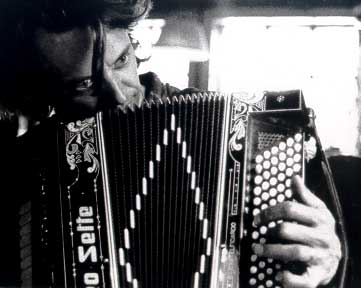
It is with some sadness that I pass on the news of the passing of Lars Hollmer, a long time friend of RootsWorld, and a regular contributor to our past Free Reed Festivals. Listen to Lars' contribution to one of our festivals, including a little talk about his piece "Sudaf".
So, Lars, "this is it, OK. Have a good time. Goodbye." - CF
Fellow musician Guy Klucevsek sends this tribute to his friend and fellow accordionist/musician.
My dear friend and Accordion Tribe colleague, Lars Hollmer, passed away on Dec. 25, 2008, at the age of 60.
I first heard Lars's music in the early 90s, through singer-songwriter and DJ extraordinaire, David Garland. I instantly recognized a kindred spirit and he was the first person I invited to be a part of what eventually became the Accordion Tribe. We began the group in 1996 and continue to this day, although there will be a gaping void on stage and in our hearts from now on.
Lars was an auto-didact and multi-instrumentalist (accordion, keyboards, voice, melodica, etc.) who was completely fearless in his approach to music. He could be unabashedly sentimental (Boeves Psalm, Soon Song), write incredibly dense and complex counterpoint with the best of them (Pas de Valse, Utflykt med Damcyckle), and be mischievous and joyfully wacked-out (Circus I, II). And that's only the Accordion Tribe repertoire! He managed to record about 30 albums in all, mostly in his legendary home studio, the Chickenhouse, both solo (11), and with his many groups, including The Looping Home Orchestra and Samla Mammas Manna.
What is the common element in all these? To quote Lars from the documentary film, "Accordion Tribe: Music Travels" (Stefan Schwietert, Maximage Films, 2002), "It all begins here," (he says, pointing to his heart); "it may go through here eventually," (he points to his head), "but it all begins with the heart." - Guy Klucevsek
Thursday, December 18, 2008
The Return of the Policewomen of Guinea
Les Amazones de Guinée
Wamato
Sterns
Ahmed Sékou Touré, the leader of Guinea’s liberation struggle against French colonial rule and president of the independent African nation from 1958 until his death in 1984, remains a controversial and polarizing figure. Revered as a freedom fighter by revolutionaries in Africa and elsewhere, he later was reviled as a dictator who trampled on human rights and mismanaged Guinea’s economy.
Touré’s one-party regime undeniably deserves the criticism. But it’s hard to argue with the results of his cultural policy, which he called authenticité. Guinea’s president made culture central to his government’s nation-building program. Artists, and especially musicians, were encouraged to create works that were modern in style but rooted in African tradition. Authenticité spawned such great bands as Bembeya Jazz, Keletigui and his Tambourinis, the Horoya Band and Les Balladins. But I can’t imagine Touré being prouder of any Guinean musicians than the women of Les Amazones de Guinée.
The band was originally called the Women’s Orchestra of the Guinean Militia, and the members indeed all were soldiers. (Some still are, with titles like “Commandant” and “Capitaine.”) They made their first and still unreleased recording in 1961, as an acoustic band. Au coeur de Paris, recorded 21 years later in the old colonial power’s capital, was their first album as Les Amazones. Sekou Touré was still alive at the time, and the propagandistic side of authenticité is evident in tracks like “PDG (Parti Démocratique de Guinée),” a praise song for the president’s political party.
But Les Amazones’ debut also displayed their feminism, in songs that urged African women to reject patriarchal tradition and claim their place in post-colonial society.
Les Amazones, notes Pierre René Worms of Radio France Internationale, “set the standard for female groups in post-independent Africa; a symbol of African woman’s emancipation, they remain a rarely imitated example.”
Now, 26 years later, we have Les Amazones’ second album, Wamato, and it is a beauty, easily the equal of the recent acclaimed release by another veteran but far better known African band, Orchestra Baobab’s Made in Dakar. Recorded in Bamako, Mali, in the same studios used by Ali Farka Toure and Oumou Sangaré, among other notables, Wamato grabs the listener from the jubilant cry of “ah-hah!” that opens the album.
The production, by Afropop veteran Ibrahima Sylla, is clean and unobtrusive, putting the focus on the guitar-driven ensemble and the amazing vocalists who front it. There are 11 core Amazones, some of whom replaced original members who died or retired. They are augmented by a dozen guest vocalists and instrumentalists, all women. But the music, thanks to Sylla and chef d’orchestre Commandant Salématou Diallo, on bass, never sounds cluttered or cacophonous.
The title track has the three main vocalists, Fatoumata N’Gady Keita, Daloba Keita, and M’Mah Sylla, trading verses while the guitarists, Yaya Kouyaté on lead, N’Sira Tounkara on rhythm, spin intertwined lines around them. And voices and guitars are the stars here, notwithstanding the tight horn section and surging percussion. Each of the vocalists has a distinctive timbre, roughly corresponding to Western categories of vocal range -- one low and earthy (contralto), another mid-range (mezzo), another high and strident (soprano). Each singer has a strong individual vocal profile and a powerful presence.
As if having three terrific lead singers wasn’t enough, the Amazones supplement them with stellar guests -- Fatou Nylon Barry, a full-throated, exuberant wonder on “Ndaren,” and Les Zawagui de Macenta, a trio of Valerie Keba, Helen Pivie and Blandine Komessa. The two tracks featuring the marvelous trio, “Deni Wana” and “Zawi,” are both exceptional, but they really kill on the latter, a joyous welcome-back to the Amazones. “Alhamdoulilah,” a rhythmic tour de force, is a showcase for the sharply contrasting but complementary voices of M’Mah Sylla, cutting yet supple, and Fatou Nylon Barry, deeper and more rough-edged.
Much of Wamato’s considerable pleasure comes from the interplay of the voices and the guitars, the pealing, dancing guitars of Yaya Kouyaté and N’Sira Tounkar. “Be Ni Son” features some of their most captivating work. “Meilleurs Voeux,” a wish for a Happy New Year, begins as a syrupy ballad sung in French by M’Mah Sylla. But, like Guinea shaking off its colonial masters, the band shifts into a quicker tempo, changes the rhythm, and surges ahead, with Yaya Kouyaté’s guitar and the horns calling and responding to each other.
It’s amazing that a band that has released only two records in nearly 50 years would sound so vibrant and confident, as if they’d never left the scene. One can only hope that Wamato, their superb return, means we’ll be hearing more from Los Amazones de Guineé, and that we won’t have to wait another 26 years for the follow-up. - George De Stefano
CD available from cdRoots
Wamato
Sterns
Ahmed Sékou Touré, the leader of Guinea’s liberation struggle against French colonial rule and president of the independent African nation from 1958 until his death in 1984, remains a controversial and polarizing figure. Revered as a freedom fighter by revolutionaries in Africa and elsewhere, he later was reviled as a dictator who trampled on human rights and mismanaged Guinea’s economy.
Touré’s one-party regime undeniably deserves the criticism. But it’s hard to argue with the results of his cultural policy, which he called authenticité. Guinea’s president made culture central to his government’s nation-building program. Artists, and especially musicians, were encouraged to create works that were modern in style but rooted in African tradition. Authenticité spawned such great bands as Bembeya Jazz, Keletigui and his Tambourinis, the Horoya Band and Les Balladins. But I can’t imagine Touré being prouder of any Guinean musicians than the women of Les Amazones de Guinée.
The band was originally called the Women’s Orchestra of the Guinean Militia, and the members indeed all were soldiers. (Some still are, with titles like “Commandant” and “Capitaine.”) They made their first and still unreleased recording in 1961, as an acoustic band. Au coeur de Paris, recorded 21 years later in the old colonial power’s capital, was their first album as Les Amazones. Sekou Touré was still alive at the time, and the propagandistic side of authenticité is evident in tracks like “PDG (Parti Démocratique de Guinée),” a praise song for the president’s political party.
But Les Amazones’ debut also displayed their feminism, in songs that urged African women to reject patriarchal tradition and claim their place in post-colonial society.
Les Amazones, notes Pierre René Worms of Radio France Internationale, “set the standard for female groups in post-independent Africa; a symbol of African woman’s emancipation, they remain a rarely imitated example.”
Now, 26 years later, we have Les Amazones’ second album, Wamato, and it is a beauty, easily the equal of the recent acclaimed release by another veteran but far better known African band, Orchestra Baobab’s Made in Dakar. Recorded in Bamako, Mali, in the same studios used by Ali Farka Toure and Oumou Sangaré, among other notables, Wamato grabs the listener from the jubilant cry of “ah-hah!” that opens the album.
The production, by Afropop veteran Ibrahima Sylla, is clean and unobtrusive, putting the focus on the guitar-driven ensemble and the amazing vocalists who front it. There are 11 core Amazones, some of whom replaced original members who died or retired. They are augmented by a dozen guest vocalists and instrumentalists, all women. But the music, thanks to Sylla and chef d’orchestre Commandant Salématou Diallo, on bass, never sounds cluttered or cacophonous.
The title track has the three main vocalists, Fatoumata N’Gady Keita, Daloba Keita, and M’Mah Sylla, trading verses while the guitarists, Yaya Kouyaté on lead, N’Sira Tounkara on rhythm, spin intertwined lines around them. And voices and guitars are the stars here, notwithstanding the tight horn section and surging percussion. Each of the vocalists has a distinctive timbre, roughly corresponding to Western categories of vocal range -- one low and earthy (contralto), another mid-range (mezzo), another high and strident (soprano). Each singer has a strong individual vocal profile and a powerful presence.
As if having three terrific lead singers wasn’t enough, the Amazones supplement them with stellar guests -- Fatou Nylon Barry, a full-throated, exuberant wonder on “Ndaren,” and Les Zawagui de Macenta, a trio of Valerie Keba, Helen Pivie and Blandine Komessa. The two tracks featuring the marvelous trio, “Deni Wana” and “Zawi,” are both exceptional, but they really kill on the latter, a joyous welcome-back to the Amazones. “Alhamdoulilah,” a rhythmic tour de force, is a showcase for the sharply contrasting but complementary voices of M’Mah Sylla, cutting yet supple, and Fatou Nylon Barry, deeper and more rough-edged.
Much of Wamato’s considerable pleasure comes from the interplay of the voices and the guitars, the pealing, dancing guitars of Yaya Kouyaté and N’Sira Tounkar. “Be Ni Son” features some of their most captivating work. “Meilleurs Voeux,” a wish for a Happy New Year, begins as a syrupy ballad sung in French by M’Mah Sylla. But, like Guinea shaking off its colonial masters, the band shifts into a quicker tempo, changes the rhythm, and surges ahead, with Yaya Kouyaté’s guitar and the horns calling and responding to each other.
It’s amazing that a band that has released only two records in nearly 50 years would sound so vibrant and confident, as if they’d never left the scene. One can only hope that Wamato, their superb return, means we’ll be hearing more from Los Amazones de Guineé, and that we won’t have to wait another 26 years for the follow-up. - George De Stefano
CD available from cdRoots
Tuesday, December 02, 2008
Sephardic roots, Mediterranean sounds

Amán Amán (L'Ham de Foc)
Música i cants sefardis d'orient i occident
Galileo
Al Andaluz Project (L'Ham de Foc and Estampie)
Deus et diabolus
Galileo (www.galileo-mc.com)
From Valencia, L'Ham de Foc approaches the Sephardic repertoire by turning east, exploring how the traditional repertoire changed as it moved from the Iberian Peninsula in the post-1492 diaspora, taking on new life in the exile communities of Sofia, Thessalonica, Istanbul, and Izmir. There is no shortage of contemporary Sephardic recordings, but the present work turns away from a certain slavish celebration of an imagined medieval multicultural sound toward a living if lesser-known Levantine tradition, complemented by instrumentation of the region (ud, tanbur, cümbüs, kopuz, santur, kemençe, various flutes, and percussion). Hence, alongside "Sien drahmas al día," the opening dance from Smyrna (a 9/8 karsilama rhythm divided in 2/2/2/3), or the hybrid "La galena y el mar" (one of many Sephardic wedding songs, a Salonika processional sung as the bride is led to her ritual bath, here with original lyrics over a Bulgarian melody), the early 20th-century Turkish curcuna (a 10/8 rhythm divided 3/2/2/3), or the Sofia lullaby "Durme," come more familiar Sephardic songs such as "El Rey Nimrod" and "Los guisados de la berenjena" (seven ways to prepare eggplant), albeit with a decidedly eastern modal makam feel. This is the spirit of "Aman, Aman," a phrase-common to many eastern Mediterranean languages-that expresses surprise, longing, or lovesickness. Notes are in Ladino, Spanish, German, and English, with lyrics in Ladino.
The Al Andaluz Project unites L'Ham de Foc with Estampie, the Munich group led by Michael Popp, better known for its dedication to medieval music. Beginning with informal collaboration based on mutual interest in older repertoires, the ensembles first shared the stage at the July 2006 Landshut Hofmusiktage festival, a performance recorded and broadcast live by Bavarian state radio. As heard on Deus et Diabolus, they followed with a November 2006 studio session at the Dominican monastery of La Cartuja de Cazalla, near Sevilla. In the spirit of Moorish Iberia, three superb female singers interpret medieval Sephardic, Arabic, and Christian traditions: Sigrid Hausen (who also plays flute), L'Ham de Foc's Mara Aranda, and Iman al Kandoussi, singing variously in Ladino, Spanish, and Arabic. Estampie's Popp (ud, saz, violin, production), Ernst Schwindl (hurdy gurdy, nyckelharpa), and Sascha Gotowtshikow (percussion) join L'Ham's Efrén López (ud, saz, rabab, hurdy gurdy, production), Aziz Samsaoui (quanun), and Diego López (percussion). Contrast the lively drone and glorious vocal harmonies of the Christian song "A virgen mui groriosa" (one of three songs dedicated to Santa María) with the driving call-and-response of Arabic-Andalusian songs like "Nassam alaina lhawa" for a sense of this recording's enchanting range. Notes are in Spanish, German, and English. - Michael Stone
Artists' web site: www.lhamdefoc.com
CDs available at cdRoots.com
Subscribe to:
Posts (Atom)